After 12+ years running food tours across Japan, our guides at Washoku Club City have walked hundreds of first-timers through their very first izakaya visit, and the questions are almost always the same: “What do I order first?” and “Why did they bring food I didn’t ask for?” If that sounds like you, you’re in exactly the right place. This guide covers izakaya etiquette ordering japan first timer essentials, from decoding the menu to nailing the drinking rituals, so you walk in confident and walk out with great stories.
What Is an Izakaya (and Why It’s Nothing Like a Restaurant)
Think of an izakaya as Japan’s answer to a pub-meets-tapas bar. You don’t go to eat a single meal and leave. You go to drink, graze through small plates, talk loudly with friends, and stay for two or three hours at minimum.
The word itself combines i (to stay) and sakaya (sake shop), the whole point is lingering. Understanding what washoku Japanese cuisine is all about helps, but izakayas sit in their own category: casual, communal, and centered on nomunication (a Japanese portmanteau of “nomu,” to drink, and “communication”).
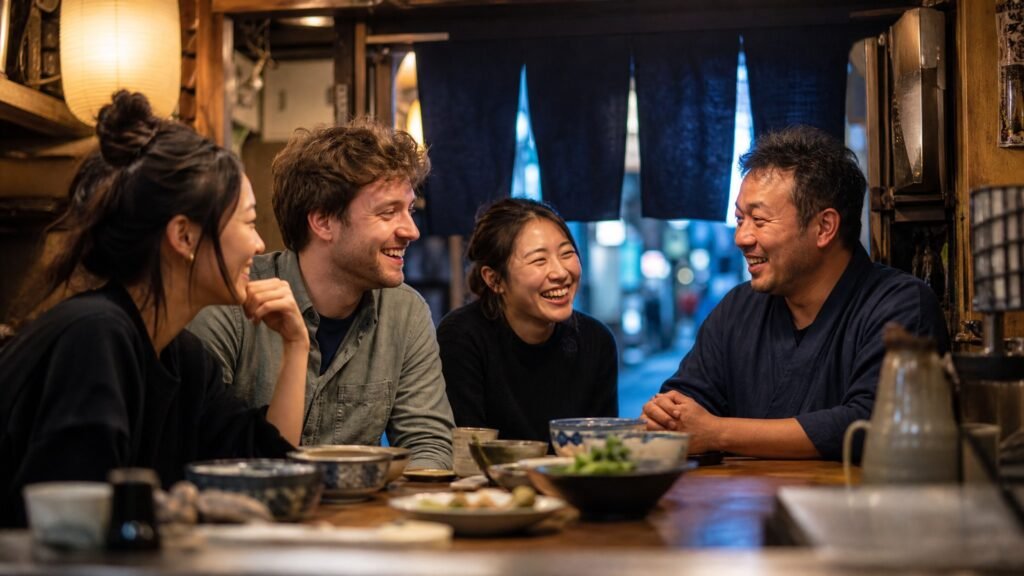
The social concept behind this is nomikai, drinking gatherings woven deeply into Japanese work and friend culture. Izakayas are where nomikai happens. The vibe is relaxed, noise levels are high, and nobody is rushing you.
The izakaya rhythm: drinks first, food in waves
The cardinal rule: order drinks the moment you sit down. A server will appear almost immediately and expect a drinks order. Don’t panic, a simple beer (biiru) or non-alcoholic option like oolong tea (uron tii) buys you time to study the food menu.
Food arrives in waves, not courses. You order a few dishes, eat them, order more, repeat. There’s no set starter-main-dessert structure. The kitchen sends things when they’re ready, so a skewer might arrive before the salad you ordered first. Go with it, that’s the rhythm.
How to Decode an Izakaya Menu Like a Local
Izakaya menus can look overwhelming: multiple pages, dense kanji, and zero pictures. Don’t panic. Most menus follow a predictable structure, drinks at the front, then divided sections for cold dishes (tsumami), hot dishes (atsumono), grilled skewers (kushiyaki or yakitori), fried items, and rice or noodle dishes to close.
Most mid-range and chain izakayas now offer QR-code menus with photos, and many have English toggles. Even without one, photos alone are enough to point and order confidently.
Spotting the must-orders: yakitori, karaage, edamame, and beyond
These dishes appear on virtually every izakaya menu and rarely disappoint:
- Edamame, salted soybeans, arrives fast, perfect with the first round of drinks
- Karaage, Japanese fried chicken, crispy and addictive, usually with a squeeze of lemon and mayo
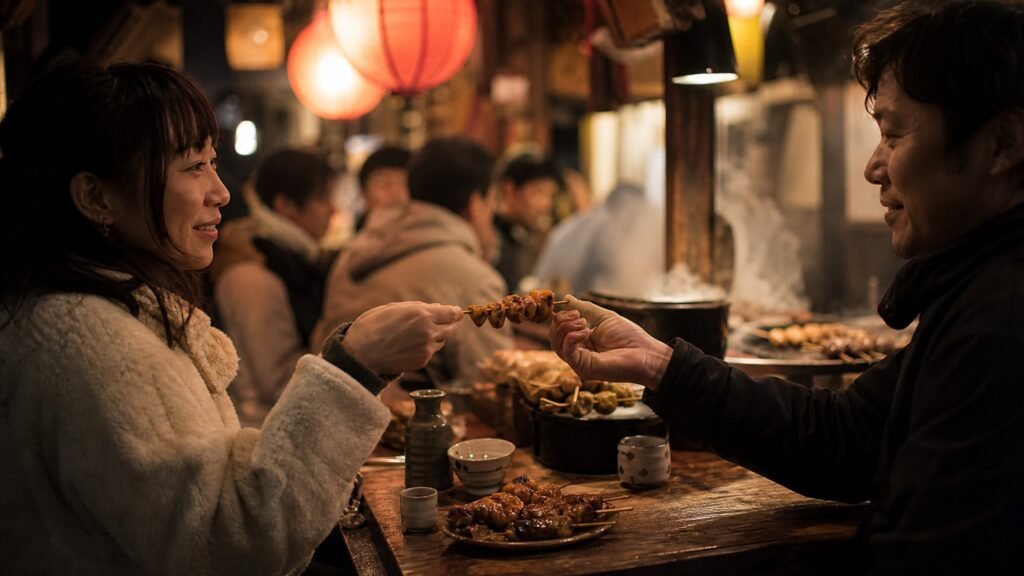
- Yakitori, grilled chicken skewers; order tare (sweet soy glaze) or shio (salt), get one of each
- Dashimaki tamago, rolled egg omelette, light and savory
- Hiyayakko, cold tofu with ginger and soy, great as a palate cleanser
- Gyoza, pan-fried dumplings, always a safe call
If you want to go deeper on Japanese food culture beyond the izakaya, our complete guide to ramen etiquette in Japan covers another essential dining experience with its own set of unwritten rules.
When there’s no English menu: photo menus, pointing, and language shortcuts
The “point and smile” approach works remarkably well in Japan. Point at a dish on the menu or a neighboring table’s plate and say:
- “Kore wo kudasai” (koh-reh woh koo-dah-sai), “This one, please.”
- “Osusume wa nan desu ka?” (oh-soo-soo-meh wah nan des kah), “What do you recommend?”
- “Onaji mono wo kudasai”, “The same as that, please” (point at what another table has).
These three phrases cover most situations. Izakaya staff are used to foreign visitors, and in 2026 many will pull up a photo menu or use a translation app themselves before you even finish the sentence.
Izakaya Ordering Etiquette: The Unwritten Rules Every First-Timer Should Know
Here’s where most first-timers get tripped up, not on what to order, but on how the system works.
The otōshi: Shortly after sitting down, a small dish will arrive that nobody ordered. This is the otōshi, an automatic appetizer charge, typically between ¥300 and ¥600 per person. It’s not a scam; think of it as a cover charge that comes with a snack. It signals you’ve secured your seat, and in most izakayas it’s a genuinely tasty little dish the kitchen is proud of. You can’t opt out, so enjoy the surprise.
Calling a server: Many first-timers sit waiting for someone to come to them. The actual move is to make eye contact and say “Sumimasen!” (soo-mee-mah-sen), “Excuse me!” with a slight raised hand. Staff respond immediately and warmly. It’s not rude; it’s expected.
Tabletop ordering systems vs. calling for staff
Many izakayas, especially chains and mid-range spots, have a tablet or touch-screen panel at each table. If yours has one, use it freely: browse, tap, and orders go straight to the kitchen. It removes all language pressure and lets your group order at their own pace.
Without a tablet, flag down a server with sumimasen for each round. Some izakayas also have a call button built into the table (often a small bell icon), press it once and someone will come within a minute.
Group ordering strategy: how to share without chaos
Going with four or more people? Nominate one person to lead the ordering, they collect everyone’s requests, call the server, and deliver the whole order at once. That’s exactly how locals do it, and it keeps things moving.
Order in rounds, not all at once. Place a first wave of three or four dishes, then reorder as those arrive and disappear. This keeps the table lively and avoids a mountain of food landing simultaneously. Shared plates go in the center; individual servings stay personal. That’s the unspoken rule.
Regional Izakaya Variations: Tokyo, Osaka, and Beyond
Not all izakayas are the same, and the city you’re in shapes the experience significantly.
Tokyo izakayas tend to be more specialized and atmospheric. The yakitori alleys tucked under the train tracks in Yurakucho, a short walk from Ginza, are among the most iconic izakaya experiences in Japan: counter seats, coal smoke, and a crowd of salarymen that hasn’t changed in decades. The focus is precise, one specialty, done perfectly, with serious drinks to match. For planning a full evening around spots like these, a Tokyo nightlife itinerary is worth bookmarking.
Osaka is a different energy entirely. In Namba and Shinsaibashi, izakayas often serve larger shared plates and the atmosphere is noticeably louder and more boisterous, locals call it Osaka nori, the city’s signature loud, jovial energy. Portions are generous, prices are often lower than Tokyo, and the crowd mixes tourists with regulars without anyone caring much. The Osaka street food scene bleeds naturally into izakaya culture here, the city eats to feel alive, and it shows.
Regional towns often have the most interesting menus. A fishing port izakaya in Hokkaido will load the menu with fresh crab and uni. A spot in Fukuoka doubles down on motsunabe (offal hot pot) and mentaiko (spicy cod roe). If you’re heading beyond the major cities, look for the handwritten specials board, that’s always the kitchen bragging about what arrived that day.
Drinking Etiquette: Kampai, Refills, and Knowing When to Stop
Getting the drinking rituals right is what separates a tourist from a welcomed regular.
Wait for the kampai. When your drinks arrive, don’t touch yours until everyone at the table has a glass and the group raises them together for kampai (cheers). Starting before the toast is a genuine faux pas. Keep eye contact during the clink, it’s considered respectful.
Don’t pour your own drink. In group settings, you pour for others and let others pour for you. Watch your neighbor’s glass and refill it when it’s low. They’ll do the same. It’s a constant, low-key act of hospitality that keeps the table warm.
Nomihōdai (all-you-can-drink) courses are offered at a fixed price for a set time window, typically 90 minutes to two hours, and are common at mid-range izakayas across Japan. They make budget planning easy for groups: a flat per-head fee covers unlimited drinks within the window. When the clock runs out, the round is over. Plan your group’s arrival time so you get the full benefit.
Beer (biiru), highball (whisky and soda), chuhai (flavored soda with shochu), and sake are the mainstays. Non-drinkers always have options, oolong tea, orange juice, and soft drinks are standard at every izakaya.
Go Deeper: Experience an Izakaya With a Local Guide
Knowing the rules is one thing. Walking into a smoky, packed izakaya where nobody speaks English, the menu is entirely in kanji, and the kitchen just sent you a mystery dish, that’s another experience entirely.
That’s exactly why we built our tours around it. A guided food tour in Tokyo with a local means you have someone who knows the neighborhood spots tourists rarely find, handles the menu translation, orders the things you wouldn’t know to ask for, and explains the why behind every ritual as it happens. No guesswork, no awkward silences with the server, no accidentally ordering ten portions of the same thing.
We take small groups through the kind of izakayas where the owner has been grilling yakitori for thirty years, places that don’t advertise online and fill up because the regulars keep coming back. It’s the fastest way to feel like a local rather than a visitor.
Japan’s izakaya culture is genuinely one of the great pleasures of traveling here. Get the etiquette right, learn a couple of phrases, and let the evening unfold in waves, drinks, small plates, good company, and another round of kampai. We’d love to be at that table with you.